What it is
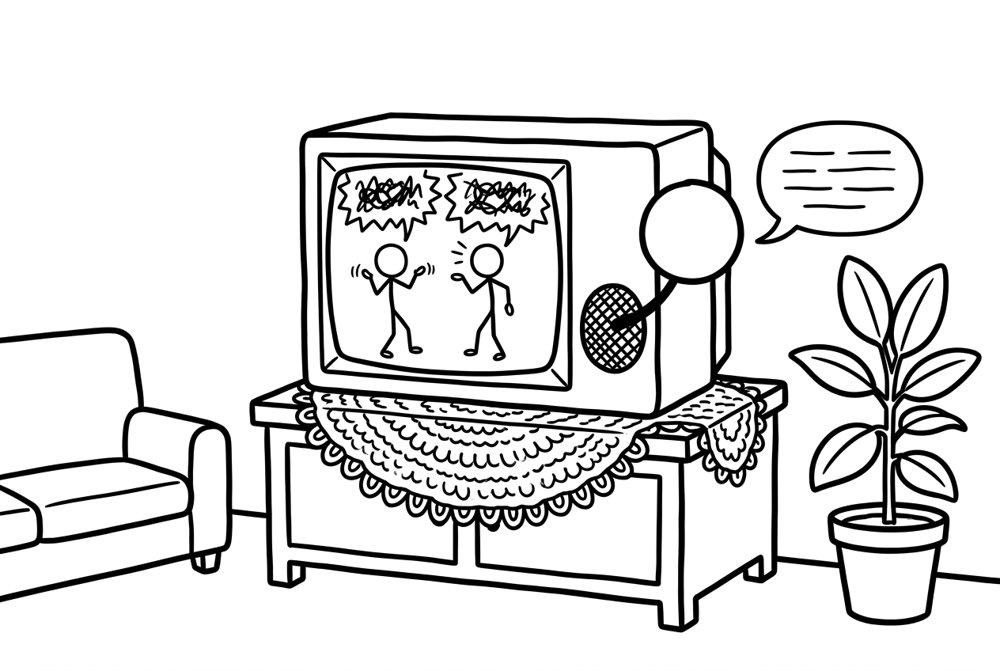
Two players on stage act out a movie in a made-up language, , and two other players translate their lines. The intent of the format is for the translator to pick up on the emotional and physical of the players on stage.
How to play
- Ask the audience. Ask the audience for a country and two foreign movie titles.
- Players and translators. Put two players on stage to act out the movie, and two more to translate their lines from gibberish. Sometimes one player translates for everybody.
- Who translates whom. Assign each player on stage their own translator: it helps the audience follow.
- Where the translators stand. The translators can stand at the front edge of the stage, on microphones.
- Pause for the translation. The player on stage says a line of gibberish, stops and waits for the translation. And their partner doesn't react or respond until the translation is in.
Whose Line Is It Anyway?
Variation: Main version
Whose Line Is It Anyway?
Variation: Main version
Tips for players
Usually in this format confusion reigns: instead of being aware of the offers and their implications for the story, the players are stuck working out whose turn it is to speak. And suddenly the translator is the complete focus of the audience's attention. In most cases the translator doesn't build on the physical offers but blocks them, contradicts them, purposefully misreads them or ignores them completely, and carries on with their previous line. The players on stage sag in response and adjust their physical actions to match the translator's joke.
Don't slip words from real languages into your gibberish. Gibberish is strongest when you are translating actual sentences into it.
If you play in gibberish, build the story as you would in any other scene. On stage and as a translator, feed your partner ideas and respond to what they give you.
You have no idea what the translator will say, so be nimble: the scene can turn on a dime.
If you create a strong environment and take up a physical activity, you will have something to focus on while you wait for the translation.
If you are a translator, translate a long speech as one short phrase, and a short sound as a long monologue. Or ramble on endlessly in your translation.
If you are a translator, censor a line that sounds obscene, or struggle with a fake idiom.
Variations
Asynchronous AsynchronousThe translators face the audience and cannot see the scene.
Translated Opera Translated OperaThe players sing their gibberish, as in an opera.
Bad Translator Bad TranslatorA real language is translated by someone who doesn't speak it.
No translation No translationPlay the whole scene in gibberish, untranslated. Or in English, freely or with a restriction: others speak for the players, or lines go one word at a time. For the best of both worlds, switch between modes.
Dubbing DubbingA related format where the players on stage stay silent: they only act, and others voice them in sync from the side. The voices respond in the moment to the movements, and the players instantly embellish every line.
Videos
Whose Line Is It Anyway?
Variation: Main version
Whose Line Is It Anyway?
Variation: Main version
Sources
Also called: Foreign Film Dub · Foreign Translator · Subtitles