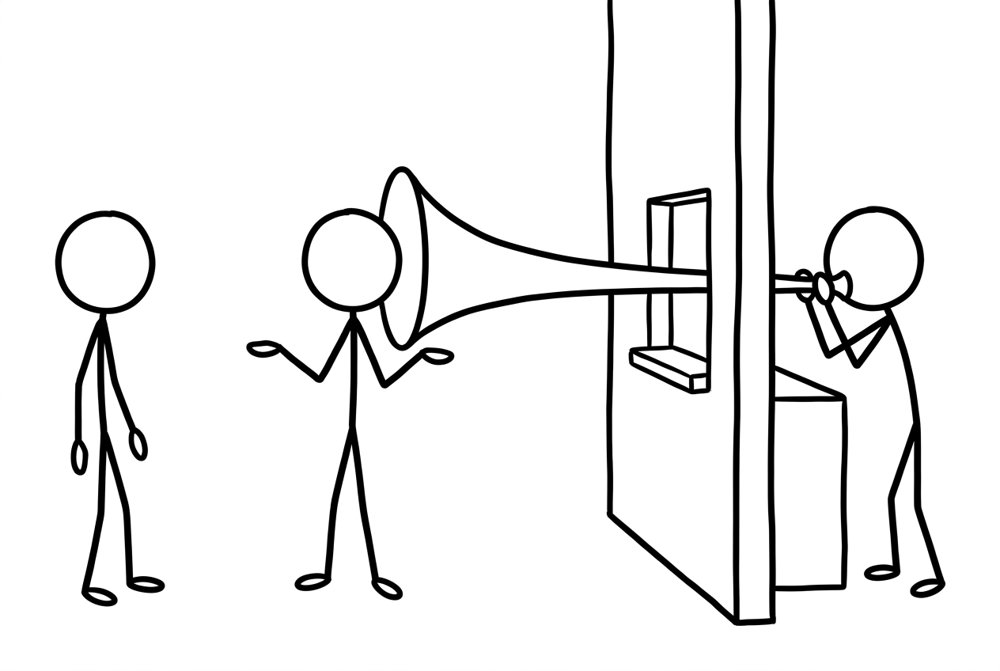
What it is
Two players act a scene in silence, while two others speak for them from offstage, lip-synching to their mouths. The offstage players and the onstage players work together.
How to play
- The lineup. Two pairs play, two on stage and two offstage: this lineup works best. For clarity, each pair can be a boy and a girl: the boy dubs the boy, the girl dubs the girl. If necessary, give the offstage players mics.
- The introduction. Ask the audience for an exciting setting for a movie. Announce who is dubbing whom: it helps both the audience and the players.
- The scene. The onstage players can start: they mouth words, and the offstage players give them voices. An offstage player stops speaking as soon as the onstage player stops moving their mouth.
Or the offstage players speak first, and the onstage players mouth along. You can also start with emotions: the offstage players weep, laugh, sigh or scream, and the onstage players lip-sync to the sounds. Then the offstage players add dialogue.
What it teaches
In this format everyone has to slow down and listen to everyone on stage. That makes it especially good for groups where some players dominate too much and bulldoze others. And once players get it, they really learn to listen to each other and share a scene.
Players pick up from different directions: both what they see and what they hear. And when it works, they feel very present with the rest of the team, perhaps for the first time.
For the voice, the format is a good exercise: the offstage player imagines the sound coming from way ahead of them. And it's an excellent way to develop funny voices.
Tips for players
Variations
 Cross DubbingUsually two players stand on stage and dub each other.
 Three Way DubbingEach player dubs another: the first dubs the second, the second the third, the third the first. Each lip-synchs to a partner's voice while dubbing the third, and that is hard enough already.
 Low Budget Voice OverOne player gives voices to everyone on stage. Voicing everyone alone can be fun, if the player has the quickness of mind and the vocal versatility. Try this too: several characters speak at once.
 Lip-SyncIn a two-person scene with no offstage voices, one player speaks for both. Make it a master and a servant: the master chooses a voice of their own and invents a quite different voice for the servant.
 Dubbed CommercialTwo or more players play teleshopping sellers, and one more sits aside from the stage and dubs them all. The audience first chooses the product.
 Film DubProject movie or YouTube clips onto the stage with the sound off; the players dub them and match the mouths on screen. Give each other offers: put an emotion in your voice.
Videos
Sources
- Hoopla Impro, London: three pages, Dubbing, Film Dub and the Short-Form Show Games list
- learnimprov.com, Hugh MacLeod: Dubbing Games and five named variations
- Lip-Sync (Impro for Storytellers, Keith Johnstone, Faber and Faber 1999, pp. 176–178: Lip-Sync, Two-way Lip-Sync, Lip-Sync from Offstage, Lip-Sync with Audience Volunteers)
- ImprovDr, David Charles, “Game Library: Dubbing”
- improwiki, the Dubbing category: Dubbed commercial, Synchro Replay, Three Way Dubbing
- Dubbing, Three-Way Dubbing, Voice-Over (The Playbook: Improv Games for Performers, William Hall)
- Dubbing (The Improv Handbook, Salinsky & Frances-White: Appendix One and the introduction to Master/Servant Dubbing)
- Dubbing, Spolin Games Online: Improvisational Library and Training
Also called: Voice Over