What it is
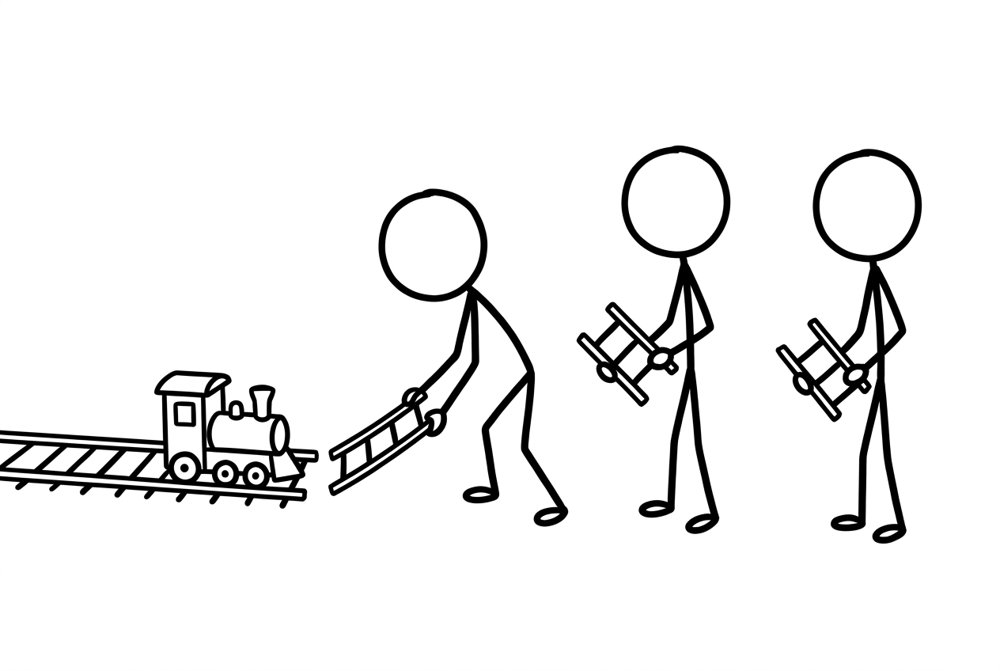
Players line up on stage and take turns speaking one word each, forming sentences and stringing the sentences into a story. The group strives to sound like one person telling a story at a normal, conversational pace.
How to play
- The lineup. You need four to eight players: line them up on stage. If there are two players, stand them opposite each other.
- A title from the audience. Ask the audience for the title of the story. A theme or a location will do instead of a title: that’s all the players need to get started.
- Word by word. Take turns saying one word each: the player at one end starts the story, the next adds the second word, and so on down the line.
What it teaches
The format trains listening and being in the present moment with each other. It teaches accepting and building on , being obvious, teamwork and storytelling. Every element of LACE shows here quite acutely: Listening, Accepting, Commitment, Expand.
The format shows why it pays to expand offers rather than explode them: small steps add up and grow stronger together. And the comedy comes out of them by accident.
Tips for players
Examples
Example 1 / 2
Improviser A and Improviser B start a story.
— Improviser A: Once.
— Improviser B: Upon.
— Improviser A: A.
— Improviser B: Time.
Example 2 / 2
Improviser A and Improviser B tell a story.
— Improviser A: There.
— Improviser B: Was.
— Improviser A: A.
— Improviser B: Man.
— Improviser A: Who.
— Improviser B: Delighted.
— Improviser A: People.
Variations
 In a CirclePlayers tell the story around a circle as fast as possible, sometimes to a beat. Throw out anyone who blocks until two are left. For a tougher circle, each speaker points to whoever says the next word: then you can’t anticipate your turn.
 EliminationAny player who delays in responding steps out of the group, and the slower players are eliminated one by one. This teaches the group to keep up the pace. A player who gives an inappropriate response is out too.
 MeeepEveryone plays, but only two are on stage at a time. They take turns saying one word, inspired by a given topic. The audience can shout “meeep” if a player hesitates, says “uh-uh”, or the story turns illogical, absurd or stupid.
 In PairsStand shoulder to shoulder, or put your arms round each other: now the two of you are one person. Tell the story in the present tense, one word at a time. Say “We” instead of “I”.
 All TogetherThe whole group presses together and tells the story all at once, starting with “We”. The chorus probably works because many people say the same words, and the majority swamps out the few who go wrong.
 LettersDivide the players into groups of four: each group composes a letter a word at a time. The players relax, and one of them writes the letter down.
Videos
Sources
- 23factsImpro: Improvisation and the Theatre
- 13factsTruth in Comedy
- 13factsHoopla Impro
- 12factslearnimprov.com
- 10factsimprowiki
- 6factsThe Improv Handbook
- 5factsImprovDr
- 4factsSpolin Games Online
- 4factsThe Art of Improvisation (in Russian)
- 3factsThe Playbook: Improv Games for Performers
- 1factIRC Improv Wiki
- 1factfuzzyco.com