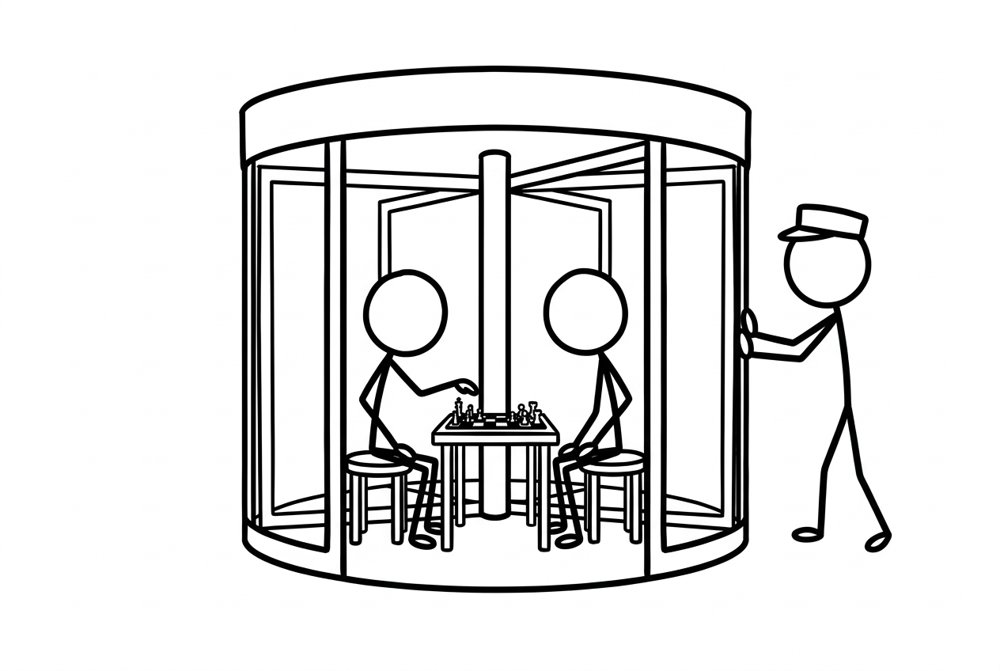
What it is
In Four Square, four players stand at the corners of a square and play short, separate scenes in pairs. It is four scenes in one: switching between them is like changing channels on a TV.
How to play
- Players. Four players stand in a square. You can also play with more: up to six, up to eight, or any number of players. Then there are always two at the front and the rest stand in a line.
- The working side. The side nearest the audience is the working side: the audience sees its pair, and the others wait behind. The downstage right corner is usually the pole position: the scene is played on the suggestion of whoever stands there, with the partner on their left.
- Suggestions. Pick a host; once you know the format, you can do without one. The host gets a different suggestion from the audience for each pair, an occupation, a location, an emotion, a relationship or a theme: “What are we watching on the first channel?”
- The start. A random pair plays the first scene on its suggestion.
- The pan. The host blows a whistle and calls “Pan right” or “Pan left”: everyone moves one place, and a new pair faces the audience. That pair starts or picks up its scene at once; from then on the host turns the square either way.
- Coming back and the end. When you come back to a pair, continue its scene some time later: a minute, a year, a generation, even in a new place. Play for about five minutes, or until each story has gone through a beginning, a conflict and a resolution.
What it teaches
The format makes you listen actively to your partners. It forces you to switch fast between two very different scenes and play two contrasting characters. It is a good format for beginners: there are only two people in each scene, and each segment of it lasts a few seconds. It also builds spontaneity: part of you wants to stop and think about the suggestion, but you don't, and you jump straight into the scene.
Tips for players
Example
Four players stand in a square: A and B at the front get “banker”, and C and D behind them get “envy”. A: — Your loan is approved, sign here. The host claps: — Turn! — the square shifts, and C and D step forward. C: — You got the best desk again! Host: — Turn! — A and B come back, right where they left off: B: — This pen doesn't write, give me another one.
Variations
 Repeat the last lineStart each new scene with the last line of the one before: the transitions get riskier, and the tempo usually rises toward the end.
 Type of suggestionVary the type of audience suggestion: genre, type of play, title of a play, TV show, film, emotion, character.
 CircleIn shows, two evenly sized teams play: the players stand in a circle facing outward, alternating by team. The two nearest the audience are the first pair, and they look straight out at the audience.
 Four-letter wordThe audience gives a four-letter word, and each player takes the next letter of it to inspire their suggestion.
 Suggestion ReviewWhen the circle is back at the first pair, the host pans it right and each pair states its suggestion, with gestures and shifts on the host's cue if you like.
 Three playersThe format also works with three: three players, three stories.
Videos
Sources
- 44factsImprovDr
- 28factsimprowiki
- 21factsThe Art of Improvisation (in Russian)
- 17factsHoopla Impro