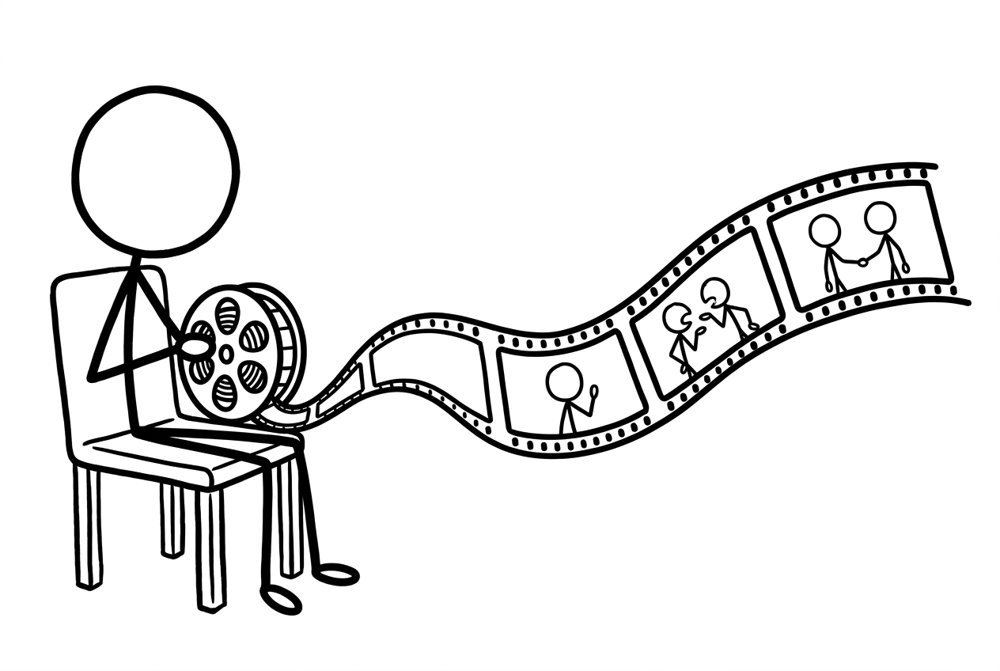
What it is
The players act out a scene from its ending to its beginning, putting the lines and actions in reverse order but saying the words as usual. It is an open scene that is open-ended, or open-beginninged.
How to play
- Running backwards. Build the scene from the last line back to the first. Say each sentence as usual: only the story runs backwards. Play actions and conversations from the end too, and show the effect before the cause. And don't use the future tense: everything has already happened.
- The story chain in reverse. Try running a familiar story chain from the end: start with the resolution, then show what raised the stakes and what the characters explored. Then introduce the characters themselves and their relationships, and finish with the setting.
History
According to Keith Johnstone, the format used to have a part in the normal order too, but now it has been lopped off: the scene is invented backwards from the start. It starts with a murder victim who immediately springs back to life.
Tips for players
Example
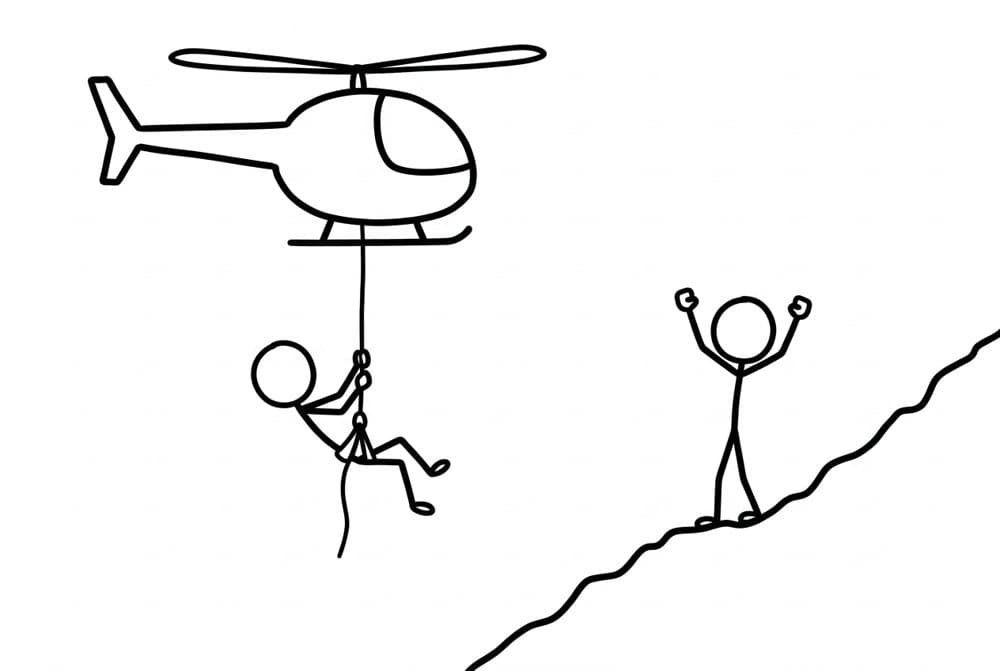
Player A is a climber, Player B cheers A on, Player C was rescued earlier, and Player D is the pilot.
— Thank you so much! I never thought we'd be rescued.
— You're nearly there, you can do this!
— The wind is picking up!
Player A gets back into the harness and moves backwards and down, toward the mountainside.
— I shouldn't have gone first. I don't know if Roman's nerves can take this…
— We can't stay here much longer!
Variations
 Backwards InterviewAs a rehearsal, play a TV interview from its end to its start: it is easy to begin, and it falls neatly into answer, question, answer, question. Then liven it up with big emotional choices.
 Murder in ReverseAfter the interview, play a scene that starts, or rather ends, with a dead body on the floor. After that the team is ready for the open version of the format.
 Audience suggestionThe host can come out and get a suggestion from the audience that could have set up such a scene, a fairly esoteric trick.
Videos
Sources
- 23factsImprovDr
- 18factslearnimprov.com
- 9factsThe Improv Handbook
- 3factsThe Playbook: Improv Games for Performers
- 2factsImpro for Storytellers